
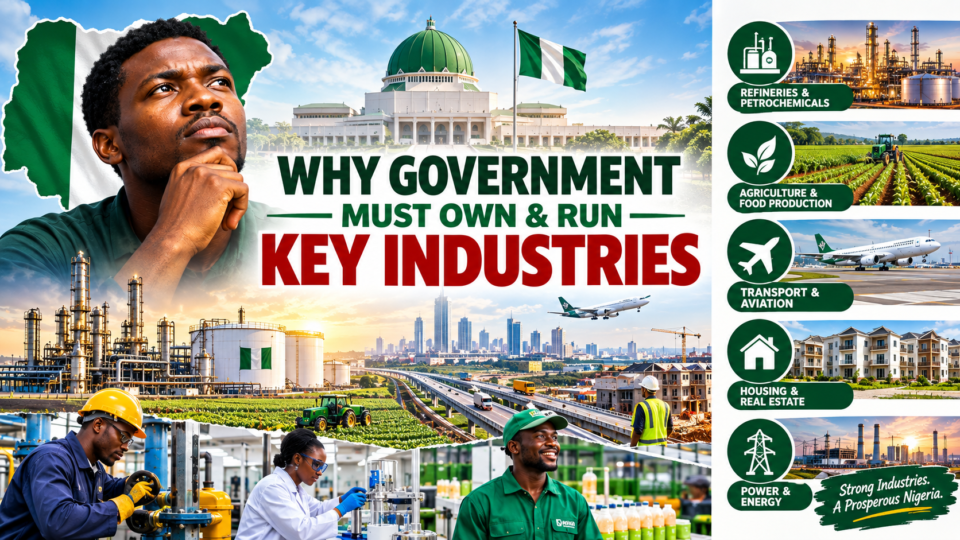
It is another sleepless night thinking about Nigeria. A line from my Principal keeps echoing in my mind, a riddle that seems to baffle even those elected to lead us: “I reason why I cannot tell.” It is a phrase that captures the paralysis of the Nigerian state, a state with resources, manpower, and mandate enough to change lives, yet one that pleads impotence whenever it is asked to drive economic transformation.
My proposal has been consistent: there are businesses the ordinary Nigerian cannot afford to enter. The barriers, be it capital, licensing, or the sheer scale of infrastructure, are too high. Nigerians do not have easy access to loans and grants for business start-ups; commercial banks do not simply hand out credit, and where they do, the security demanded and the interest rates are killers. Therefore, I have argued that government should not merely own a substantial share of certain enterprises as a silent, dividend-collecting partner. It must run them. It must employ Nigerians. Government must be the engine, not the backseat driver.
We have the human and natural resources. We just need to get to work. We need to farm, refine our crude, build our homes, and construct our roads. Our lethargic government is busy waiting for foreign investors or the private sector to deliver these things. Is this not foolishness? Government has the capital and the power to pull this off. So what, exactly, is government doing?
Look at the current reality. Aliko Dangote is selling shares to the public. This is a masterclass in how private individuals and organisations can involve the masses in wealth creation. It demonstrates that the ordinary Nigerian is not just a beast of burden destined for the labour market; he can be an owner. The reaction of Nigerians to the Dangote opportunity, the scramble for shares, the hope of dividends, proves that our people are hungry for economic participation. They do not merely want to sweep the factory floor; they want to own a brick in the wall.
So I ask: why is our government so allergic to the very concept of doing business? How can our leaders insist that government cannot do business? When they say this, they are inadvertently or perhaps deliberately telling us that their own ministries and parastatals are not fit for purpose. They are admitting that the civil service is a graveyard of inefficiency and that the public sector cannot compete. But this is a self-fulfilling prophecy. If you staff an agency with political cronies rather than technocrats, if you starve it of funding while expecting miracles, and if you treat it as a cash cow for political patronage, of course it will fail.
The question that keeps me awake is simple: What are these government staff and agencies paid for? We have entire ministries dedicated to industry, trade, and investment. We have parastatals galore. We pay salaries, allowances, and overheads running into billions of naira every month. If government cannot do business, what is the job description of these thousands of employees? Are they merely administrators of poverty? Are they just there to file papers while the private sector, often foreign or a tiny local elite, controls the commanding heights of the economy?
Take Delta State as a microcosm of this national tragedy. The state budgeted a staggering N500 billion for the economic sector. N500 billion! That is not pocket change; it is the GDP of some small nations. Yet what is the tangible result? Where are the state-owned refineries? Where are the state-run farms that should be feeding the nation? Where are the transport companies that should be moving goods and people at affordable rates? If that N500 billion were invested in state-run enterprises with the ruthlessness and efficiency of a private company, Delta State would not just be an oil-producing state; it would be an industrial powerhouse.
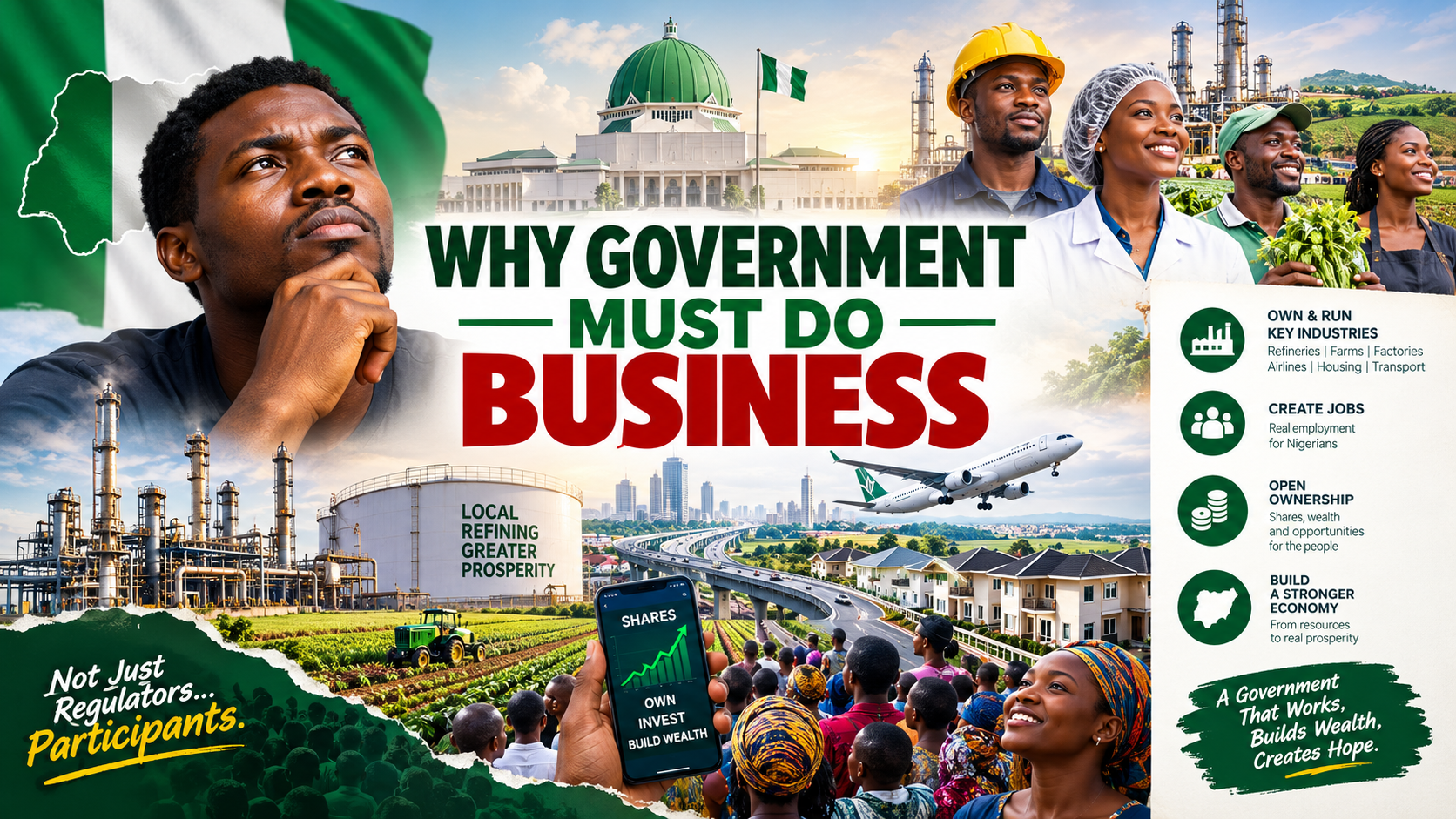
The argument that government has no business in business is a lazy excuse for corruption and incompetence. It is a way for the political class to abdicate responsibility to the people and hand over the nation’s wealth to a select few private individuals who then hold government to ransom. We must change the narrative. Government must run businesses. It must employ Nigerians. It must provide the capital that the ordinary man lacks and give the ordinary man the opportunity to buy shares, just as Dangote is doing.
We need a government that owns refineries and runs them, not one that sells them off because it cannot manage them. We need a government that owns airlines that fly on time, not one that grounds its fleet and leases private jets for its officials. We need a government that builds houses and sells them at cost to the masses. We need a government that treats public enterprise as a public trust, not a private trough.
If government cannot do business, then it should not collect taxes from businesses. If it cannot run an agency, it should not budget for it. But I believe we can do better. We must demand a government that is not just a regulator but a participant, a government that understands that the ordinary Nigerian is not only a worker but a potential shareholder. Until then, the sleepless nights will continue, and the riddle of our underdevelopment will remain unsolved.
Ogbevire Christian Ashaiku (AKA Daddy Kris)
Human Rights Activist
PhD Research Fellow
Middlesex University London
