
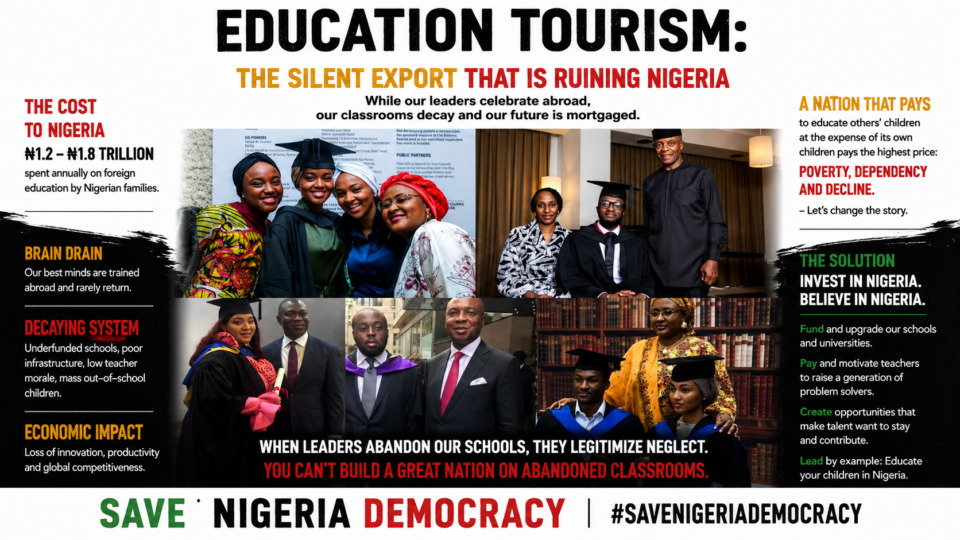
Michael Jackson once joked that if everyone in Hollywood who had plastic surgery went on holiday, the town would be empty. The same could be said of Nigerian leaders who send their children abroad for education. While every parent has the right to choose the best for their child, when those entrusted with fixing Nigeria’s education system routinely bypass it, the nation’s future hangs in the balance.
The numbers paint a grim picture. Nigeria ranks as the third-largest source of international students globally, with over 142,000 Nigerians enrolled in foreign universities across major destinations like the UK, US, and Canada. We have an estimated 18.3 million out-of-school children, which is the highest in the world. The country consistently fails to meet UNESCO’s recommendation of allocating 15–20% of the national budget to education. Nigeria’s best in recent years was just 7.9% in 2024, with allocations hovering between 4.9% and 7.9% from 2019 to 2025. Even worse, states spent a meagre N6,981 per capita on education in 2024, and no state implemented its education budget fully.
Consider the cost of foreign education. An average child studying in the UK can cost around 120 million naira when tuition, accommodation, and health insurance are factored in. Recent estimates suggest a UK degree through traditional pathways costs roughly £60,000 (over N120 million) per year.
A stark example recently emerged as former NMDPRA CEO Farouk Ahmed allegedly spent $5 million (approximately N7.5 billion) educating four children in Switzerland. According to Peter Obi, that sum could educate 6,000 Nigerian children annually, employ 450 teachers, and establish a self-sustaining education ecosystem through prudent investment.
The irony is painfully clear. Many lecturers in UK universities are Nigerian-trained academics who left due to poor conditions at home. So, it is a scenario of Nigerian students in British classrooms taught by Nigerian lecturers.
The right to education is enshrined as a fundamental human right in the International Covenant on Economic, Social and Cultural Rights (Article 13), and intentional and severe deprivation of the right to education constitutes persecution when committed as part of a widespread or systematic attack against a civilian population.
When those entrusted with governing Nigeria systematically underfund education, allocating as little as 4.9% of the national budget against UNESCO’s 15–20% recommendation, while simultaneously investing vast public resources in foreign education for their own children, they perpetuate a system that denies millions of Nigerian children their fundamental rights. The European Union has explicitly stated that denial of education constitutes institutionalised, systematic discrimination.
The future of Nigeria depends on fixing education at home, not funding classrooms in London and Boston. Nigeria is indeed under siege by its elites. Our democracy is under threat as it cannot deliver for citizens with this action and inaction of our leaders. As the saying goes, for evil to triumph, good men do nothing. It is time for all Nigerians to demand accountability. It is time to Save Nigeria’s Democracy.
#SaveNigeriaDemocracy
Ogbevire Christian Ashaiku
Human Rights Activist
PhD Law Research Fellow, Middlesex University, London
